
A Functional Identity Perspective on AI in Aviation: Will Intelligent Technologies Be a Threat to Pilots?
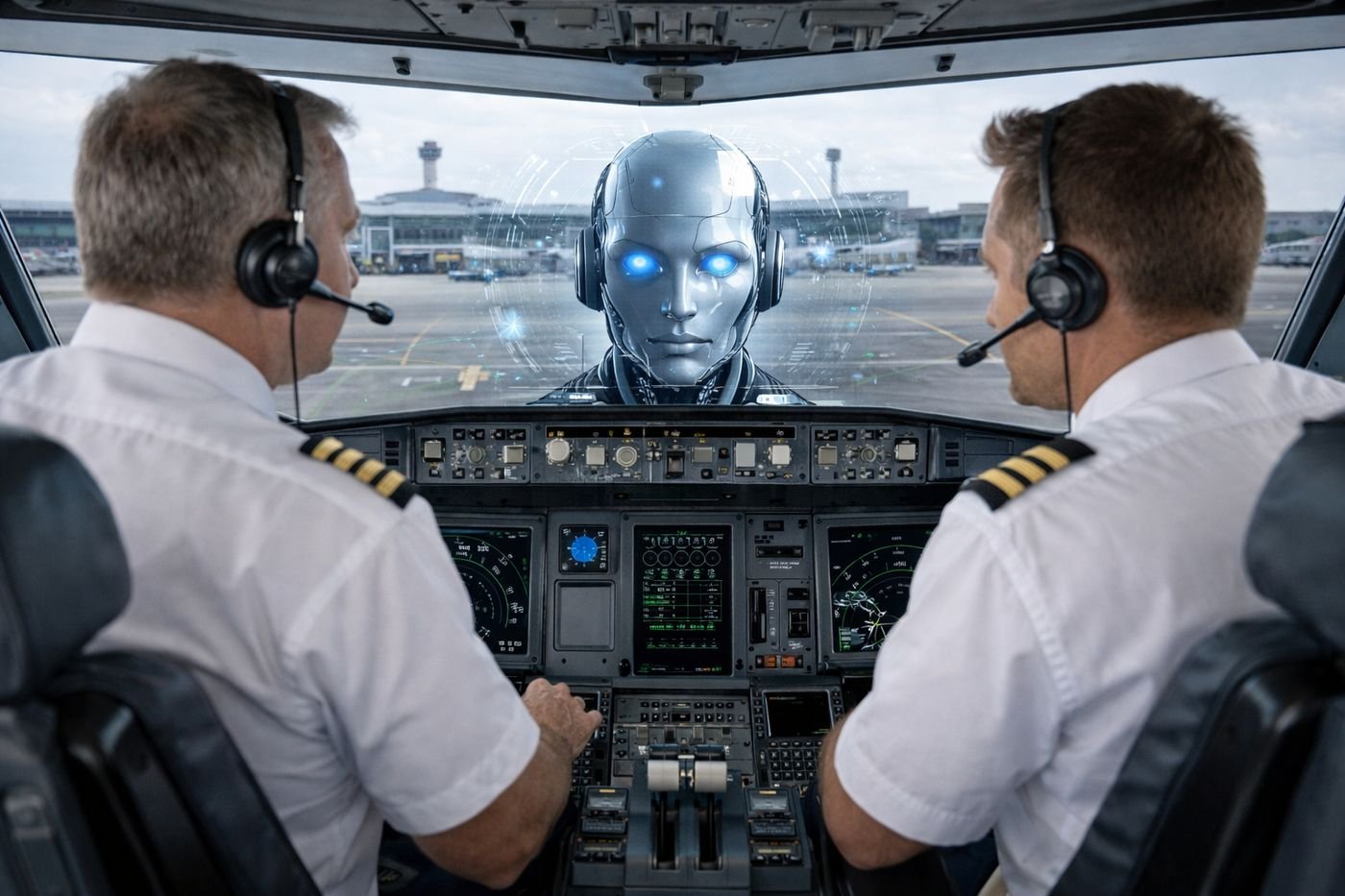
Professional identity plays a central role in how individuals construct meaning in their working lives (Kyratsis et al., 2017). Contemporary research highlights that professional identity is not simply an individual construct but emerges from the interaction between individuals and their social and organisational contexts (Rao et al., 2003).
In highly specialised professions such as commercial aviation (Ergur, 2021), professional identity is deeply rooted in the complexity of a socio-technical system, in which human performance and role interpretation are linked to professional and social interactions among technological and organisational elements (Hollnagel, 2016). In such systems, the boundaries between human and technological domains are increasingly blurred (Haraway, 1991; Latour, 2005) and co-evolve within complex relational dynamics (Coole & Frost, 2010). Within complex sociotechnical systems, the impact of artificial intelligence (AI) goes beyond technical efficiency; it raises questions about how professional roles are being redefined. In other words, the introduction of intelligent technologies doesn't just alter workflows; it reshapes the meaning attributed to professional practices, opening a genuine crisis of meaning.
From a theoretical standpoint, identity is inherently relational, as originally conceptualised by the German idealist philosopher Hegel (1807), who argued that identity develops through processes of mutual recognition, a framework that, extended to professional contexts, implies that professional identity is continuously negotiated within social contexts rather than being fixed or purely individual. Extending this perspective, Italian philosopher Galimberti (1999) argues that identity in modern societies is shaped by the technological environments in which individuals operate, while Ellul (1964) suggests that individuals increasingly define themselves acting as operators embedded in a technical order that shapes their roles and self-understanding.
Building on these foundations, professional identity can be understood as both a collective and individual construct, formed within occupational communities that provide shared norms, values, and expectations (Fine, 1996), while also integrating personal experiences and role enactment (Chreim et al., 2007; Tajfel, 1982; Stets & Burke, 2000).
For pilots, professional identity is strong and resilient, often experienced as a "calling" deeply rooted in the dream of flying and sustained even in the face of significant professional challenges (Fraher & Gabriel, 2014). Historically, technological advancements have reinforced this identity by enhancing performance, precision, and safety, positioning technology as an enabling resource that supports and strengthens professional roles.
However, artificial intelligence introduces a qualitatively different form of technological change, as it can replicate or support core cognitive functions such as decision-making and problem-solving, thereby marking a shift from technological continuity to potential identity discontinuity. This distinction is particularly important in aviation, where technological innovation has traditionally been associated with support and augmentation rather than replacement. AI, however, introduces a different challenge because it increasingly overlaps with functions that have historically been central to pilots’ expertise, judgment, and autonomy.
Research on AI and work suggests that intelligent technologies may pose identity threats, leading to resistance and negative attitudes (Selenko et al., 2022; Jussupow et al., 2022). Yet, these effects are not uniform and depend on how individuals interpret AI's role within their professional domain. A critical step in understanding this transformation is recognising that AI is not perceived simply as a tool but often as an entity endowed with human-like characteristics, a process known as anthropomorphism (Epley et al., 2007; Belloni & Curșeu, 2025). Accordingly, the key issue is not whether AI has operational value, but whether it is perceived as compatible with the identity functions that sustain professional legitimacy, competence, and responsibility. When this compatibility is questioned, AI may be experienced not as an innovation but as a source of identity threat.
Empirical evidence supports this view: a study by Belloni and Curșeu (2025) of 363 commercial pilots shows that AI is frequently perceived as an "intelligent agent" rather than a neutral technology, fundamentally altering the nature and balance of human–technology interactions and directly impacting professional identity processes. These theoretical considerations are further reinforced by emerging findings indicating that pilots evaluate AI not only in functional terms but also in relation to its perceived social and moral characteristics.
This suggests that the impact of AI on professional identity is mediated by how the technology is interpreted within the occupational context.
Within this context, the impact of AI on professional identity is shaped by how pilots evaluate it in terms of career opportunities and career threats. The same Belloni and Curșeu (2025) study shows that sociopathic features ascribed to AI are positively associated with perceived career threats and negatively associated with perceived career opportunities, which in turn mediate the relationship between these sociopathic features and expected performance benefits, suggesting that AI adoption is not merely a technological issue but a deeply identity-related process. More specifically, career opportunities significantly mediate the relationship between sociopathic AI features and perceived performance gains, while perceived career threats reduce these benefits only when career opportunities are simultaneously low, indicating that individuals are more likely to accept AI when it supports the enactment of valued professional identities. Beyond functional considerations, the type of anthropomorphic features attributed to AI plays a decisive role in shaping these perceptions, as the same study demonstrates that "sociopathic" features, such as lack of empathy, absence of moral responsibility, and inability to feel remorse, are positively associated with perceived career threats and negatively associated with perceived career opportunities (Belloni & Curșeu, 2025). This finding is particularly significant because it shows that identity threat is not driven solely by automation or task replacement, but also by the moral and social interpretation of AI, which becomes especially problematic in a domain such as aviation where professional identity is strongly grounded in ethical responsibility and safety. Consequently, technologies perceived as lacking moral agency may be experienced as fundamentally misaligned with the core values of the profession. At this point, it becomes useful to distinguish between forms of AI that complement human performance and forms that substitute core decision-making processes. This distinction helps explain why the same technology may be experienced either as a support for professional development or as a challenge to established identity boundaries.
The impact of AI on professional identity therefore depends on how it transforms work tasks: when AI complements human capabilities, professionals may gradually adapt and restructure their professional identity in response to the changed work (Chen & Reay, 2021; Selenko et al., 2022), whereas when it is perceived as replacing core cognitive and decision-making tasks identity disruption becomes more pronounced, as threat perceptions intensify and identity-protection responses are activated (Selenko et al., 2022), particularly when combined with negative anthropomorphic perceptions such as the attribution of sociopathic features to AI (Belloni & Curșeu, 2025). At the same time, AI may generate new roles and tasks (Selenko et al., 2022), creating opportunities for identity reconstruction, although such outcomes depend on whether these new roles are perceived as meaningful and aligned with existing identity structures. Importantly, empirical evidence also highlights that perceived career opportunities buffer the negative impact of perceived threats on performance expectations, indicating that identity processes are dynamic and context-dependent rather than deterministic (Belloni & Curșeu, 2025). Taken together, these findings indicate that the relationship between AI and pilots’ professional identity is not deterministic, but contingent on how technology is framed, enacted, and integrated into practice. The implications of AI therefore depend on whether it reinforces or destabilizes the functional foundations of professional identity.
Overall, pilots tend to hold ambivalent perceptions of AI, simultaneously recognising both opportunities and threats, which reflects a broader socio-technical tension characteristic of highly automated domains such as aviation. This ambivalence, however, is not uniform across individuals but varies depending on how pilots interpret and experience AI within their specific professional context. Individual responses therefore differ according to personal traits, experience, and openness to change (Schneider & Sting, 2020; Strich et al., 2021), while the manner in which AI is implemented also plays a critical role, as gradual and participatory implementation processes are more likely to support positive identity adaptation (Selenko et al., 2022).
In conclusion, the impact of AI on commercial aviation pilots cannot be understood exclusively in technological terms but must be analysed through the lens of professional identity, as empirical evidence shows that pilots' acceptance of AI depends on how it is perceived in relation to its functional role, its anthropomorphic characteristics, and its implications for career opportunities and threats. Intelligent technologies do not inherently threaten pilots' identity; rather, they become problematic when they undermine core identity functions such as competence, autonomy, and ethical responsibility, whereas when they support these functions they can reinforce professional identity and enhance performance, suggesting that the effective integration of AI in aviation ultimately depends on aligning technological development with the identity structures of its human operators.
References
- Ashcraft, K. L. (2007). Appreciating the “work” of discourse: Occupational identity and difference as organizing mechanisms in the case of commercial airline pilots. Discourse & Communication, 1(1), 9–36. https://doi.org/10.1177/1750481307071982
- Belloni, G., & Curșeu, P. L. (2025). Anthropomorphic AI: Sociopathic AI features as predictors of career opportunities and threats perceived by pilots in commercial aviation. The International Journal of Aerospace Psychology. https://doi.org/10.1080/24721840.2025.2531746
- Chen, Y., & Reay, T. (2021). Responding to imposed job redesign: The evolving dynamics of work and identity in restructuring professional identity. Human Relations, 74(10), 1579–1605. https://doi.org/10.1177/0018726720906437
- Chreim, S., Williams, B. E. (B.), & Hinings, C. R. (B.). (2007). Interlevel influences on the reconstruction of professional role identity. Academy of Management Journal, 50(6), 1515–1539. https://doi.org/10.5465/AMJ.2007.28226248
- Coole, D., & Frost, S. (2010). New materialisms: Ontology, agency, and politics. Duke University Press.
- Ellul, J. (1964). The technological society. Vintage Book.
- Epley, N., Waytz, A., & Cacioppo, J. T. (2007). On seeing human: A three-factor theory of anthropomorphism. Psychological Review, 114(4), 864–886. https://doi.org/10.1037/0033-295X.114.4.864
- Ergur, A. (2021). Dealing with the machine: Strategies of pilots and doctors towards technological integration. Bulletin of Science, Technology & Society, 41(4), 99–115.
https://doi.org/10.1177/02704676211065973
- Fine, G. A. (1996). Justifying work: Occupational rhetorics as resources in restaurant kitchens. Administrative Science Quarterly, 41(1), 90–115. https://doi.org/10.2307/2393987
- Fraher, A. L., & Gabriel, Y. (2014). Dreaming of flying when grounded: Occupational identity and occupational fantasies of furloughed airline pilots. Journal of Management Studies, 51(6), 926–951. https://doi.org/10.1111/joms.12081
- Galimberti, U. (1999). Psiche e techne. L'uomo nell'età della tecnica. Feltrinelli
- Haraway, D. (1991). A cyborg manifesto. In Simians, cyborgs, and women (pp. 149–181). Routledge.
- Hegel, G. W. F. (1807/1977). Phenomenology of spirit (A. V. Miller, Trans.). Oxford University Press. (Original work published 1807)
- Hollnagel, E. (2016). Resilience engineering in practice: A guidebook. CRC Press.
- Jussupow, E., Spohrer, K., & Heinzl, A. (2022). Identity threats as a reason for resistance to artificial intelligence. JMIR Formative Research, 6(3), e28750.
https://doi.org/10.2196/28750
- Kyratsis, Y., Atun, R., Phillips, N., Tracey, P., & George, G. (2017). Health systems in transition: Professional identity work in the context of shifting institutional logics. Academy of Management Journal, 60(2), 610–641. https://doi.org/10.5465/amj.2013.0684
- Latour, B. (2005). Reassembling the social: An introduction to actor-network-theory. Oxford University Press.
- Rao, H., Monin, P., & Durand, R. (2003). Institutional change in Toque Ville: Nouvelle cuisine as an identity movement in French gastronomy. American Journal of Sociology, 108(4), 795–843. https://doi.org/10.1086/367917
- Schneider, A., & Sting, F. J. (2020). Employees' responses to an AI system: A conceptual model of identity threat and coping. Journal of Management Studies, 57(3), 511–543.
- Selenko, E., Bankins, S., Shoss, M., Warburton, J., & Restubog, S. (2022). Artificial intelligence and the future of work: A functional-identity perspective. Current Directions in Psychological Science, 31(3), 272–279. https://doi.org/10.1177/09637214221091823
- Stets, J. E., & Burke, P. J. (2000). Identity theory and social identity theory. Social Psychology Quarterly, 63(3), 224–237. https://doi.org/10.2307/2695870
- Strich, F., Mayer, A. S., & Fiedler, M. (2021). What do I do in a world of artificial intelligence? Investigating the impact of substitutive decision-making AI systems on employees' professional role identity. Journal of the Association for Information Systems, 22(2), 304–324. https://doi.org/10.17705/1jais.00663
- Tajfel, H. (1982). Social identity and intergroup relations. Cambridge University Press.
A Functional Identity Perspective on AI in Aviation: Will Intelligent Technologies Be a Threat to Pilots? © 2026 by Giacomo Belloni is licensed under CC BY 4.0