
How Advanced Air Mobility and eVTOL Will Change Common Perceptions and Acceptance of Automation
Abstract
The development of electric vertical take-off and landing (eVTOL) aircraft, as part of the Advanced Air Mobility (AAM) project, represents a seismic shift in urban mobility that might lead to the general public's gradual acceptance and confidence in autonomous technology. eVTOL will introduce new levels of automation and independence fuelled by cutting-edge technologies and artificial intelligence. This article examines how eVTOL capabilities will impact public perceptions of advanced and intelligent technologies in aviation in general. It highlights how eVTOL advances will significantly change public confidence in machine autonomy.
Introduction
During this time, there is growing debate about advanced technologies and AI and the exclusion or marginalisation of human operators from controlling complex machines. We have frequently argued that the aviation industry, influenced by economic considerations, is advancing too quickly without considering the consequences of an unchecked push for implementation in public air transport (Salas & Maurino, 2010).
Air accident investigations too frequently reveal that overly complex engineering designs have overlooked the critical and delicate relationship between the operator and his onboard control interfaces. Thus, with opposed and sceptical positions towards this design trend, the arguments of many professional associations seek to sensitise users to make them aware of the importance of pilots as fundamental assets on board aircraft and of their irreplaceability (how can one not disagree?).
However, the authors believe a novel, determining element must be considered to build objective and complete contrasting theses against this rampant engineering design culture: AAM and eVTOL aircraft.
AAM and eVTOL projects are so innovative, groundbreaking, and inevitable that some deem it unlikely to become a reality soon. The technology that equips these machines is impressively advanced, and the control interfaces are so simple and minimal that, after an initial experimental phase, the roadmap of the designers even foresees that eVTOL would be autonomous by 2035 (Xiang et al., 2024). These machines are designed to operate with incredible precision and consistency, relying on AI, sophisticated algorithms, and high-level sensors to execute manoeuvres or make decisions independently from their human operators.
AAM and eVTOLs are closer than one might suppose. Archer Aviation, one of the leading eVTOL manufacturers, has already announced plans to launch air taxi services in Abu Dhabi, likely by the end of 2025. The project, in agreement with the Abu Dhabi Investment Office (ADIO), includes hundreds of millions of dollars in investment (Hein, 2024).
Today, big cities are always more populated and congested, and noise and pollution are becoming unsustainable. AAM is emerging as a critical solution to transportation challenges such as traffic congestion, long commuting times, and urban sprawl. eVTOL aircraft are designed to take off, land and cruise electrically, and promise to provide an efficient, low-emission means of transportation. "eVTOL has the potential to revolutionise transportation by providing fast, efficient, and environmentally friendly machines" (Xiang et al., 2024, p. 10).
In AAM and eVTOL projects, players from academia, authority [Federal Aviation Administration (FAA) and the European Union Aviation Safety Agency (EASA)], and industry (such as NASA, Boeing, Airbus, Uber, the US Army, Lilium, Joby Aviation, Volocopter, E-Hang, and many others) are investing billions (Xiang et al., 2024). More than 600 eVTOL prototypes at different maturity levels (Emerson et al., 2023) are ready to be developed and produced.
Technological Foundations of eVTOL
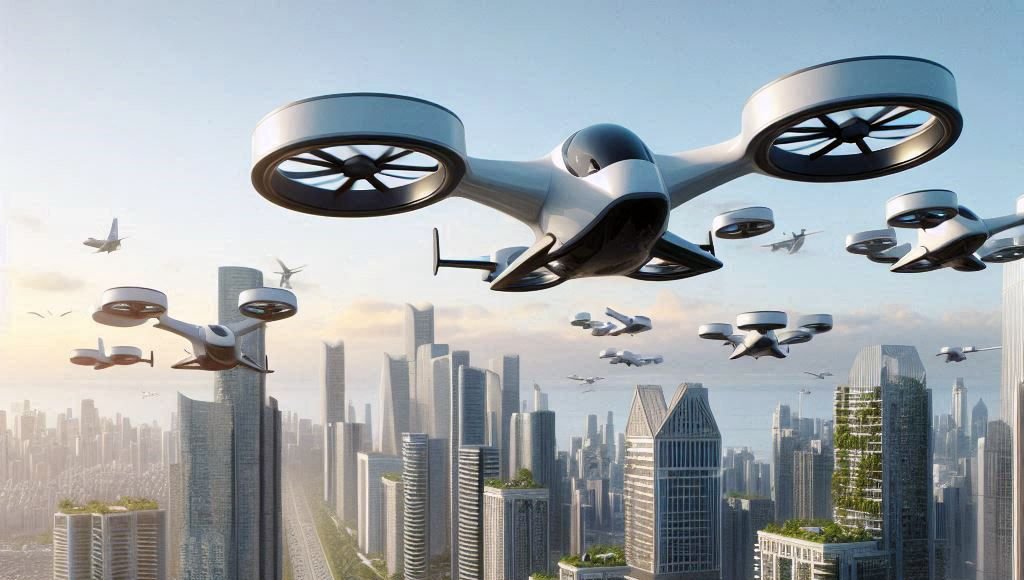
eVTOL aircraft use electric propulsion and innovative aerodynamic designs to achieve vertical take-off and landing. It is made possible by distributed electric propulsion (DEP), where multiple rotors generate lift and thrust, allowing for efficient flight with fewer moving parts than traditional helicopters. These aircraft come in different configurations, such as multi-rotor, tilt-rotor (wing), compound, and tail-sitter, each offering specific benefits in terms of efficiency, noise reduction, and manoeuvrability (Xiang et al., 2023).
AI plays a crucial role in the automation of eVTOL systems. Machine learning algorithms enable predictive maintenance, optimising flight paths based on real-time data, and ensuring safety through advanced fault detection systems. AI-powered decision-making systems are being developed to handle complex situations, such as avoiding mid-air collisions or responding to system malfunctions, thus mimicking or surpassing human piloting capabilities (Shin & Singh, 2023).
Changing Public Perceptions of Automation and AI
Full Automation can evoke fears of losing control and trust in technology, while more transparent and gradual implementations tend to improve acceptance. Public trust in automation builds gradually as people become familiar with technological advancements and see them working reliably over time. If we had told our grandparents about today's fully automated train shuttle between airports' terminals, they would have stared at us suspiciously and sceptically. Nowadays, we use these shuttles without even thinking there is no human operator at their wheel (Interlandi, 2024).
The shift from piloted aircraft to autonomous eVTOL will similarly reshape attitudes toward automation, but potentially on a much larger scale. eVTOL's integration into daily life will be a litmus test for public trust in autonomous systems. The widespread use of these machines will largely depend on their ability to demonstrate consistent safety, reliability, and efficient operations. If they can achieve this, it is reasonable to believe that public anxiety and scepticism will gradually diminish, and society may become ready to accept autonomous flight as part of everyday life, just like we have seen with automated transport in other industries.
Conclusion
The development and adoption of eVTOL aircraft represent a transformative moment for urban air mobility and automation. As eVTOL technology matures towards full autonomy, it has the potential to reshape the public's perception and acceptance significantly. If safety and reliability prove superior, the shift from human to AI-driven aircraft will inevitably lead to broad acceptance of these systems. However, societal adaptation will require addressing psychological barriers, ethical considerations, and all the other potential impacts. Thus, eVTOL marks an evolution in aviation and serves as a barometer for the future of autonomous technology.
Avoiding the risk of overlooking this topic is crucial amid the push to implement this promising technology. Like previous industry or cultural revolutions, no one knows whether this change will create or eliminate jobs. At the moment, "the initial need for eVTOLs is estimated to be around 100,000 new pilots, and this is just the beginning" (Voipo, 2022, p. 59).
The future is inevitable and is knocking at the door. Pilots' representatives would need to sit at the decision-making table and be active protagonists, together with the industry and regulatory bodies, in managing the profound and inevitable changes of the near future.
How Advanced Air Mobility and eVTOL Will Change Common Perceptions and Acceptance of Automation © 2024 by Giacomo Belloni and Fabrizio Interlandi is licensed under CC BY-NC 4.0
References
• Anderson, J. (2023). The Future of Pilots in a World of Autonomous Flight. Aviation Journal, 34(2), 127–139.
• Carmody, K, Chauhan, B., Namukasa, M., Sharma, V., Berkel, G., Adorno, Y., Carroll, M. (2023). Human Factors Training Implications for Urban Air Mobility Operations. Interservice/Industry Training, Simulation, and Education Conference (I/ITSEC)
• Clark, D. (2024). Safety Protocols for Autonomous eVTOL in Urban Areas. Aerospace Safety, 46(1), 25–37.
• Emerson, S. N., Rizzardo, C., Osman, M. C. (2023). How Simple is Simple? Measuring Learning Trajectories in Emerging eVTOL Aircraft. Conference Paper · January 2023.
• Hein, T. (2024). AAM in the UAE. Vertical Magazine. https://verticalmag.com/features/aam-in-the-uae/
• Patterson, R. (2022). Autonomy in eVTOL: A New Era for Aviation Automation. International Journal of Aviation, 52(4), 211–226.
• Salas, E., Maurino, D. (2010). Human Factors in Aviation, 2nd edition. Elsevier.
• Shin, K., & Singh, A. (2023). Machine Learning and Predictive Maintenance for eVTOL Systems. Journal of Intelligent Transportation Systems, 29(1), 83–95.
• Skyler, B. (2024). Human Error and Automation: Lessons from Aviation for Autonomous eVTOL. Human Factors Journal, 61(2), 202–213.
• Smith, L., & Brown, A. (2023). Public Perception of Autonomous Air Travel: Psychological and Social Barriers.Journal of Applied Psychology, 78(2), 145–160.
• Xiang, S., Xie, A., Ye, M., Yan, X., Han, X., Niu, H., Li, Q., Huang, H.(2023). Autonomous eVTOL: A summary of researches and challenges. Research Center for Intelligent Robotics, Zhejiang Lab, Hangzhou.